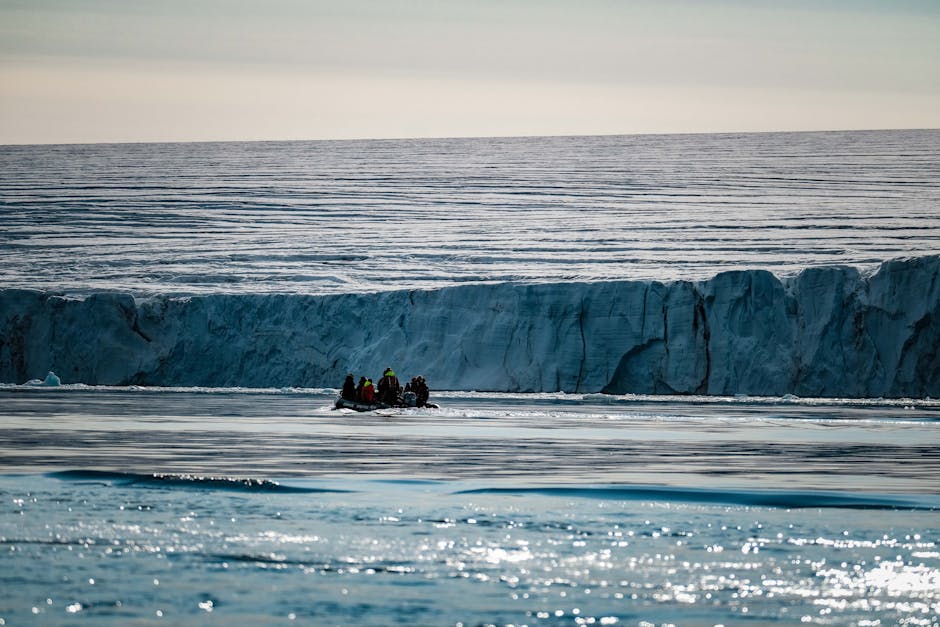
A groundbreaking new study has unveiled a trove of hidden secrets beneath Antarctica's rapidly melting ice sheets, particularly in the vulnerable West Antarctic region. Researchers have discovered not only previously unknown vast subglacial river networks and ancient landscapes but also thriving, unique microbial ecosystems powered by geothermal activity, fundamentally altering our understanding of the continent's dynamic environment and its potential for life.
Background
Antarctica, the Earth's coldest and most isolated continent, has long been perceived as a desolate expanse, its immense ice sheets concealing a barren bedrock. Early 20th-century explorations, epitomized by figures like Ernest Shackleton and Robert Falcon Scott, focused on the harsh surface, confirming its extreme conditions. For decades, scientific inquiry primarily involved mapping the ice surface and studying atmospheric phenomena.
The mid-20th century marked a shift with the advent of geophysical surveys and early ice core drilling, which began to hint at the complex geology beneath the ice. The discovery of Lake Vostok in the 1970s, a vast subglacial freshwater lake trapped beneath miles of ice, sparked initial curiosity about the potential for life in extreme conditions. However, direct access remained challenging, and the prevailing view largely held that such environments were isolated and largely devoid of active biological processes.
The late 20th and early 21st centuries saw a dramatic increase in focus on Antarctica due to escalating concerns about global climate change. Satellite observations, starting in the 1990s, revealed undeniable evidence of ice sheet thinning and glacier acceleration, particularly in West Antarctica, home to the Thwaites and Pine Island Glaciers. These developments underscored the urgent need to understand the subglacial environment, as meltwater at the ice-bed interface is a critical factor influencing ice flow and overall stability. Technological advancements, including sophisticated airborne radar, gravimetry, and increasingly capable autonomous underwater vehicles (AUVs), finally provided the tools to peer beneath the vast frozen expanse with unprecedented detail, setting the stage for the recent revelations that are now reshaping our understanding of this enigmatic continent.
Key Developments
The new research, leveraging advanced remote sensing and targeted sub-ice drilling operations, has delivered a series of astonishing discoveries that challenge long-held assumptions about Antarctica's subglacial realm. These findings paint a picture of an active, dynamic, and surprisingly biodiverse world hidden beneath miles of ice.
Active Subglacial Hydrological Systems
One of the most significant revelations is the extent and activity of subglacial hydrological networks. Previous models often depicted isolated subglacial lakes. The new data, however, reveals an interconnected system of rivers and vast lakes, actively draining and refilling. These channels, some extending for hundreds of kilometers beneath the West Antarctic Ice Sheet, are transporting significant volumes of meltwater towards the Southern Ocean. The dynamic nature of these systems, with water moving at rates previously underestimated, suggests a profound influence on the lubrication of the ice-bed interface, potentially accelerating glacier flow towards the coast. Satellite altimetry and seismic surveys have detected rapid changes in lake levels, indicating active drainage events that can occur over weeks or months, redistributing vast quantities of water beneath the ice.
Evidence of Geothermal Heat Sources
The study also provides compelling evidence of widespread geothermal activity beneath parts of West Antarctica. While some localized hotspots were previously suspected, the new data indicates more extensive areas where heat from the Earth's interior contributes significantly to basal ice melt. This includes regions where the Earth's crust is thinner, allowing more heat to escape, and potentially active volcanic or magmatic systems. High-resolution heat flow measurements, combined with magnetic anomalies detected by airborne surveys, point to these geological heat sources as critical drivers of melt, creating stable liquid water environments deep beneath the ice. This geothermal influence acts independently of atmospheric warming and introduces a complex variable into ice sheet stability models.
Unveiling of Ancient Landscapes
Beneath the ice, researchers have mapped vast, ancient landscapes, revealing a dramatic topography of mountains, valleys, and even extensive river systems carved by water before the continent was encased in ice. In some regions, particularly near the Transantarctic Mountains, radar penetration has revealed sedimentary layers and even fossilized tree remains, suggesting that parts of Antarctica once supported temperate forests millions of years ago, prior to significant glaciation. These paleogeographic insights offer a unique window into Antarctica's deep past, providing crucial context for understanding its long-term climate history and the evolution of its ice sheets. The preservation of these features beneath the protective ice offers an unparalleled archive of Earth's environmental history.
Detection of Novel Microbial Ecosystems
Perhaps the most exciting discovery is the identification of thriving, diverse microbial ecosystems within these subglacial environments. Using sterile hot-water drilling techniques and advanced metagenomic sequencing, scientists have sampled water and sediment from several newly accessed subglacial lakes and river systems. These analyses have revealed communities of extremophilic microorganisms that derive energy not from sunlight, but through chemosynthesis, metabolizing chemical compounds found in the bedrock, such as iron, sulfur, and methane. These organisms represent entirely new branches on the tree of life, uniquely adapted to perpetual darkness, high pressure, and nutrient-limited conditions. Their existence fundamentally expands our understanding of the limits of life on Earth and has profound implications for astrobiology, offering terrestrial analogues for potential life on icy moons like Europa or Enceladus.
Rapid Ice Melt Acceleration
The study confirms and elaborates on the accelerating rate of ice melt, particularly in the Amundsen Sea Embayment, home to the Thwaites and Pine Island Glaciers. The newfound understanding of subglacial hydrological networks and geothermal hotspots directly links these internal processes to the observed surface melt and glacier retreat. Meltwater at the base of glaciers acts as a lubricant, enabling faster ice flow. Furthermore, the interaction of warm ocean currents with the edges of ice shelves, exacerbated by basal melt from below, is contributing to the rapid thinning and destabilization of these critical buttresses that hold back the massive ice sheets. The study projects that if current trends continue, certain ice shelves could collapse within decades, leading to a significant increase in global sea level contributions.
Impact
The revelations from this study carry profound implications across multiple scientific disciplines and for global society, reshaping our understanding of Earth's systems and the future challenges we face.
Global Sea Level Rise
The most immediate and tangible impact concerns global sea level rise. The discovery of extensive subglacial hydrological networks and widespread geothermal activity beneath West Antarctica suggests that the ice sheet's stability is more precarious than previously understood. Meltwater at the base of glaciers acts as a lubricant, accelerating their flow into the ocean. If the Thwaites Glacier, often dubbed the "Doomsday Glacier," and its neighbors continue their rapid retreat, they could contribute several meters to global sea levels over the coming centuries. This would have catastrophic consequences for coastal communities worldwide, leading to increased frequency and intensity of storm surges, inundation of low-lying areas, and salinization of freshwater resources. Millions of people living in megacities like Miami, Shanghai, and Kolkata, along with countless island nations, face displacement and significant economic disruption.
Climate Science and Modeling
These new findings necessitate a significant revision of existing climate models. Previous models often simplified the subglacial environment, underestimating the role of basal melt and geothermal heat. Incorporating these dynamic subglacial processes, particularly the interconnectedness of water systems and localized heat sources, will lead to more accurate projections of ice loss and its contribution to sea level rise. This improved understanding is crucial for refining future climate scenarios and informing international policy decisions, such as those made under the Paris Agreement. Better predictive capabilities will allow for more effective adaptation strategies and mitigation efforts globally.
Biological and Astrobiological Research
The discovery of diverse extremophilic microbial ecosystems beneath miles of ice is a monumental breakthrough for biology and astrobiology. It expands the known limits of life on Earth, demonstrating that complex ecosystems can thrive in perpetual darkness, high pressure, and nutrient-limited conditions, powered solely by chemosynthesis. This provides a powerful terrestrial analogue for the potential existence of life on icy moons in our solar system, such as Jupiter's Europa or Saturn's Enceladus, which are thought to harbor vast subsurface oceans. The unique metabolic pathways of these Antarctic microbes could offer insights into the origins of life on Earth and inform future missions designed to search for extraterrestrial life, guiding where and how to look.
Geological and Geophysical Understanding
The detailed mapping of ancient landscapes and the identification of widespread geothermal activity offer unprecedented insights into Antarctica's deep geological history. The preserved paleogeography beneath the ice provides a direct record of the continent's past, including periods when it was warmer and supported vegetation. Understanding the distribution of geothermal heat flow helps to refine models of plate tectonics and mantle dynamics beneath the Antarctic continent, revealing how crustal thinning and volcanic activity influence the overlying ice sheets. This contributes to a holistic understanding of Earth's internal processes and their interaction with surface environments.
International Cooperation and Geopolitics
The heightened scientific interest and the strategic importance of understanding Antarctica's role in global climate systems underscore the critical need for sustained international cooperation. The Antarctic Treaty System, which designates the continent for peaceful scientific research and prohibits military activity and resource extraction, faces renewed scrutiny as these "hidden secrets" emerge. While the treaty has largely been successful, the potential for discovering unique biological resources or even mineral deposits, though currently prohibited, could spark future discussions. Maintaining the spirit of scientific collaboration and environmental protection, as enshrined in the treaty, becomes even more vital in light of these new discoveries.
What Next
The groundbreaking revelations from beneath Antarctica's melting ice mark the beginning of a new era of polar research, necessitating a concerted global effort to explore, understand, and manage these newly revealed environments.
Further Exploration and Sampling
The immediate priority is to expand direct access and sampling of these subglacial environments. This will require the development and deployment of even more advanced drilling technologies capable of reaching deep subglacial lakes and rivers with minimal environmental contamination. Robotic probes, including autonomous underwater vehicles (AUVs) specifically designed for extreme cold and high-pressure conditions, will be crucial for navigating and mapping these newly discovered hydrological networks and collecting biological and geological samples without human intervention. International collaborations, such as the proposed "Deep Antarctic Life and Geothermal Exploration" (DALGE) initiative, are being formed to coordinate expeditions to critical areas like the Thwaites Glacier region and newly identified geothermal hotspots.
Long-term Monitoring Networks
Establishing a comprehensive, long-term monitoring network across key subglacial regions is essential. This would involve deploying arrays of sensors beneath the ice, capable of transmitting real-time data on water temperature, pressure, flow rates, chemical composition, and microbial activity. These sub-ice observatories would provide continuous insights into the dynamic interactions between the ice sheet, the bedrock, and the subglacial water systems. Such data streams, integrated with satellite observations and atmospheric models, will be vital for understanding seasonal and decadal changes, providing early warnings of potential ice sheet instability, and tracking the evolution of these unique ecosystems.
Refinement of Climate Models
The new data on subglacial hydrology and geothermal heat sources must be rapidly integrated into global climate and ice sheet models. This will lead to more accurate projections of future ice loss from Antarctica and its contribution to global sea level rise. Model refinements will include sophisticated representations of basal melt processes, the interaction of meltwater with ice flow, and the feedback loops between ocean warming, ice shelf stability, and subglacial dynamics. These improved predictive capabilities are crucial for policymakers to develop robust adaptation and mitigation strategies, allowing coastal communities and national governments to prepare for the inevitable impacts of rising seas.
Bioprospecting and Conservation
The discovery of novel microbial ecosystems presents both immense scientific opportunity and significant ethical challenges. The unique metabolic pathways and biochemical compounds produced by these extremophiles could hold potential for biotechnological applications, such as novel enzymes or pharmaceuticals. However, any bioprospecting efforts must be carefully balanced with the urgent need for conservation. These isolated ecosystems are incredibly fragile and susceptible to contamination. International scientific bodies and environmental organizations are advocating for strict protocols and possibly designating certain areas as "Antarctic Subglacial Protected Zones" to ensure the preservation of these pristine environments and their unique biodiversity for future generations of research.
Public Awareness and Education
Effectively communicating the significance of these discoveries to a global audience is paramount. Engaging the public through accessible science communication initiatives, documentaries, and educational programs will foster a greater understanding of Antarctica's critical role in the Earth system and the urgent need for climate action. Translating complex scientific findings into relatable narratives will help build public support for sustained polar research, international cooperation, and policies aimed at mitigating climate change, ensuring that these hidden secrets inspire a collective commitment to protecting our planet.